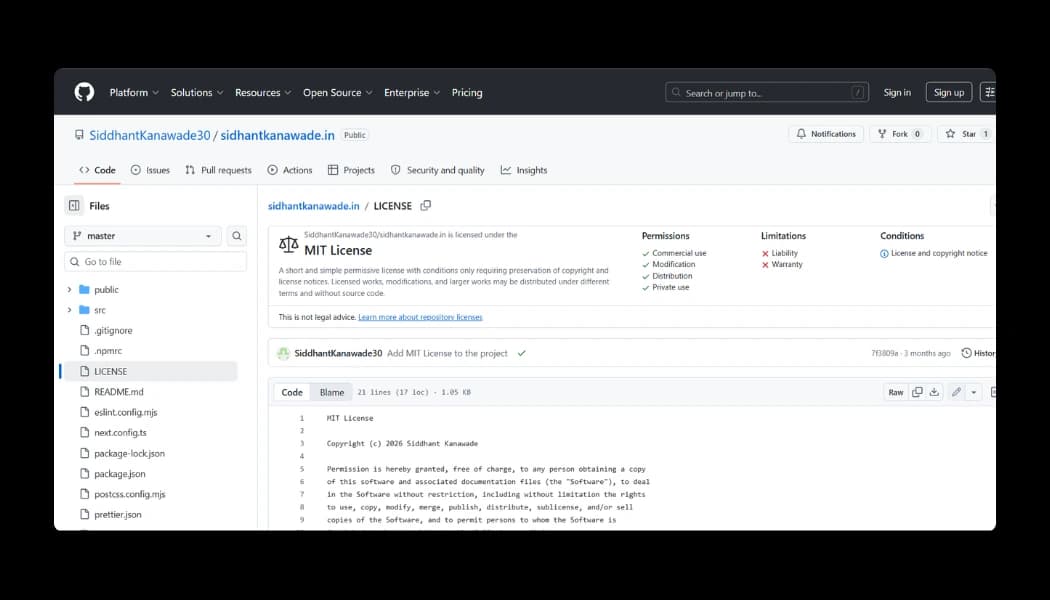
Understanding Software Licensing
In modern software development, understanding licensing is not optional. Whether you contribute to open source projects, build your own applications, or work on commercial software, licenses define the legal framework that governs how code can be used, modified, and distributed.
Many developers encounter terms like MIT, Apache, GPL, BSD, and proprietary agreements without fully understanding the practical impact. That confusion can lead to legal risk, licensing conflicts, or accidental restrictions on your own work.
This guide explains the major software license families, the most common licenses you will encounter, and the key decisions developers should make when choosing or evaluating a license.
Chapter 1: What Is a Software License?
A software license is a legally binding agreement that defines the permissions, restrictions, obligations, and rights regarding the use, modification, distribution, reproduction, and sale of software. It is the document that grants specific rights under defined conditions while protecting the intellectual property of the original creator.
Why licenses matter
Without an explicit license, software is governed by default copyright. In most jurisdictions, the creator automatically owns the exclusive rights to the work from the moment it is created. That means others generally do not have legal permission to:
- Use the software
- Modify the code
- Distribute or share it
- Create derivative works
Even if code is visible on GitHub, that does not mean it is free to use. A public repository without a license is not an invitation to reuse the code.
The license as a legal document
A software license functions as a contract between:
- The licensor: the creator or owner of the software
- The licensee: the person or organization receiving permission to use it
The license specifies what is allowed, what is prohibited, what conditions must be met, and what happens if the terms are violated.
Common components of a software license
The common parts of a software license usually include:
- Grant of rights: specific permissions given to the licensee
- Restrictions: actions that are explicitly prohibited
- Conditions: requirements that must be followed
- Copyright notice: attribution to the original creator
- Patent terms: patent-related grants or restrictions
- Termination: conditions under which the license ends
- Disclaimer: warranty and liability limitations
- Jurisdiction: governing legal framework
Chapter 2: The Two Primary Categories of Software Licenses
Software licenses usually fall into two broad categories:
- Open source licenses
- Proprietary licenses
These categories represent different approaches to access, redistribution, and control.
Open source vs. proprietary licenses
The core differences are easy to remember:
- Source code access: open source is publicly available, while proprietary code is hidden or restricted
- Modification rights: open source allows anyone to modify, while proprietary software limits changes to the owner or authorized developers
- Distribution rights: open source usually permits redistribution, while proprietary software restricts it without permission
- Commercial use: open source is generally permitted for commercial use, while proprietary software is often paid or restricted
- Cost: open source is usually free, while proprietary software is often subscription-based or sold under a commercial license
- Support: open source usually relies on community support with optional paid services, while proprietary software is vendor-supported
- Transparency: open source is highly transparent, while proprietary software is opaque by design
- Primary goal: open source focuses on collaboration and sharing, while proprietary licensing focuses on control and monetization
Chapter 3: Open Source Licenses
Open source licenses comply with the Open Source Definition maintained by the Open Source Initiative. In practice, open source software must allow redistribution, access to source code, modification, and derivative works under the license terms.
The open source model emphasizes:
- Collaboration
- Transparency
- Freedom
- Sharing
Subcategory 1: Permissive licenses
Permissive licenses are the most flexible open source licenses. They allow broad reuse with minimal conditions, usually just attribution.
MIT License
The MIT License is one of the most widely used open source licenses in web development and frontend frameworks.
Permissions:
- Commercial use
- Modification
- Distribution
- Private use
- Patent use
Conditions:
- Include the original copyright notice
- Include the license text
Why it matters:
MIT is simple, permissive, and easy to adopt. It is a strong default choice for personal projects and libraries that should be easy for others to reuse.
Well-known projects using MIT:
- React
- Next.js
- Vue.js
- Tailwind CSS
- Jest
Apache License 2.0
Apache 2.0 is a permissive license like MIT, but it adds explicit patent protections and more detailed legal language.
Permissions:
- Commercial use
- Modification
- Distribution
- Private use
- Patent use
Conditions:
- Include copyright notice
- Include license text
- State modifications
- Preserve notices
Why it matters:
Apache 2.0 is often preferred for enterprise software and large projects because the patent grant reduces legal uncertainty.
Well-known projects using Apache 2.0:
- Kubernetes
- TensorFlow
- Android core components
- Kafka
BSD Licenses
BSD licenses are traditional permissive licenses with similar freedom to MIT.
Common variants include:
- BSD 2-clause
- BSD 3-clause
- BSD 4-clause
The 3-clause version adds a no-endorsement clause.
ISC License
ISC is functionally similar to MIT but shorter and more concise.
zlib License
The zlib/libpng license is one of the most permissive licenses available. It is especially common in low-level libraries and compression tools.
Subcategory 2: Copyleft licenses
Copyleft licenses require derivative works to remain under the same license. The goal is to ensure that improvements stay open and available to the community.
GPL (GNU General Public License)
GPL is the best-known strong copyleft license. If you use GPL code in a project, the combined work typically must also be GPL.
Permissions:
- Commercial use
- Modification
- Distribution
- Private use
Conditions:
- Include copyright notice
- Include license text
- Release derivative works under GPL
- Provide source code
- Allow further modification
Why it matters:
GPL keeps software free in the sense that derivative works must also remain open.
LGPL (GNU Lesser General Public License)
LGPL is designed for libraries. It allows proprietary applications to link to the library while requiring modifications to the library itself to remain under LGPL.
AGPL (GNU Affero General Public License)
AGPL extends GPL to networked software. If you run AGPL code as a service, users interacting with the service must be offered the source code.
This is especially relevant for cloud applications and SaaS products.
MPL (Mozilla Public License)
MPL is a weak copyleft license with file-level copyleft. Modified files remain under MPL, while unmodified files can use different licenses.
Why it matters:
MPL is useful when a project wants some copyleft protection without requiring the entire codebase to be open under the same license.
Other notable open source licenses
- EPL (Eclipse Public License)
- CPL (Common Public License)
- SSPL (Server Side Public License)
Creative Commons licenses
Creative Commons licenses are mainly for content such as documentation, images, and media, not software itself. They are still useful for blog assets, tutorials, and educational materials.
Chapter 4: How Many Open Source Licenses Exist?
There are many open source licenses in circulation, but only a small subset is used heavily in practice.
For most developers, the important licenses to understand are:
- MIT
- Apache 2.0
- GPL
- BSD
- MPL
If you encounter an unfamiliar license, it is often a variant of one of these common families.
Chapter 5: Proprietary Licenses
Proprietary licenses, also called closed-source licenses or commercial licenses, are used when the developer or company retains full control over the software. The source code is hidden, and users receive limited rights through a contractual agreement.
Philosophy and purpose
The proprietary model is based on:
- Intellectual property protection
- Monetization
- Control over modification and distribution
- Centralized development and support
Common restrictions in proprietary licenses
Proprietary licenses often restrict:
- Reverse engineering
- Copying
- Modification
- Redistribution
- Scope of use
- Competitive use
Common proprietary license types
- End-user license agreement (EULA)
- Commercial license
- Subscription license
- Perpetual license
- Volume license
- Site license
- Node-locked license
Examples of proprietary software
- Microsoft Windows
- macOS
- Adobe Photoshop
- Microsoft Office
- AutoCAD
- Visual Studio
- Oracle Database
Chapter 6: Practical Guidance for Developers
For open source contributors
- Check the license before using any code
- Understand the permissions and obligations
- Document your compliance when needed
- Avoid license mixing mistakes
- Respect the project’s terms when contributing
For project creators
- Add a license file to your repository
- Choose an established license rather than inventing one
- Match the license to your goal
- Specify the version clearly when relevant
For commercial developers
- Audit dependency licenses
- Check for compatibility issues
- Understand patent clauses
- Keep records of compliance
- Consult legal counsel for complex cases
Quick recommendations
- Maximum simplicity and adoption: MIT
- Enterprise use with patent protection: Apache 2.0
- Force openness of derivatives: GPL
- Allow proprietary linking for libraries: LGPL
- Mixed open and proprietary code: MPL
Chapter 7: Summary
Software licenses define what others can legally do with your code. Open source licenses such as MIT, Apache 2.0, GPL, BSD, and MPL support public collaboration under different levels of restriction. Proprietary licenses, by contrast, preserve control and limit redistribution.
For most developers, the safest approach is simple:
- Use a recognized license
- Read the terms before reusing code
- Keep license compatibility in mind
- Ask questions early when a license is unclear
If you are starting a new project and want broad adoption, MIT is often the easiest choice. If you need patent protection for enterprise use, Apache 2.0 is a strong option. If you want derivative works to remain open, GPL is the clearest copyleft model.
The bottom line is straightforward: licensing is part of writing software responsibly, not an afterthought.
Chapter 8: Resources and Further Reading
If you want to dive deeper into software licensing or need a quick reference for your next project, bookmark these highly recommended resources:
Official & Authoritative Sources
- Open Source Initiative (OSI) - Approved Licenses: The official stewards of the Open Source Definition. This is the definitive repository of recognized open-source licenses.
- GNU Operating System - Licenses: The Free Software Foundation's official documentation detailing the philosophy, terms, and FAQs for the GPL, LGPL, and AGPL.
Practical Tools for Developers
- Choose a License: A straightforward guide built by GitHub that helps developers select a license based on simple project goals.
- GitHub Docs - Licensing a Repository: Official documentation on how to add a license file to a GitHub repository and how it interacts with the platform's terms of service.
Plain English Translations & Compliance
- TLDRLegal: A useful resource that translates complex software licensing jargon into simple, scannable Can, Cannot, and Must bullet points.
- Snyk - Open Source Licenses Explained: A modern guide focusing on enterprise implications, including license compatibility, dependency chains, and compliance.